How UV Rays Fade Your Car Paint and What You Can Do About It
UV rays fade car paint by breaking down the clear coat from the top down, and Australian sun does it faster. How to tell fade from dirt, and what actually slows it.
Muscle Hand Car Wash
Muscle Hand Car Wash
September 8, 2026
Table of Contents
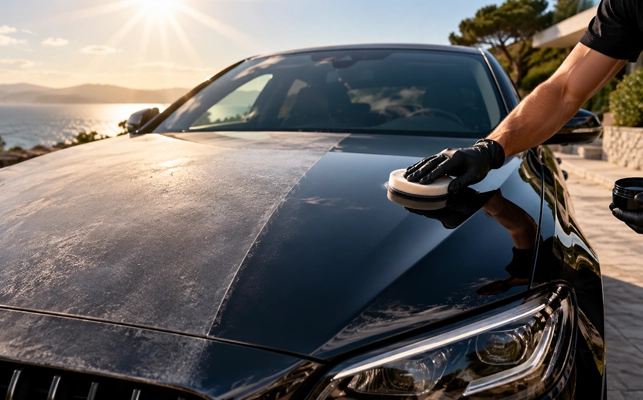
UV rays fade car paint from the top down. Sunlight is absorbed by the clear coat, breaks the bonds holding that polymer together, and sets off a chain of oxidation that ends with a surface that’s gone flat, then chalky. It happens on every car parked outside. In Australia it happens faster, because we get some of the highest UV levels on the planet.
Here’s what’s actually going on under that dull bonnet, how to tell fading from dirt, and what genuinely slows it down.
The clear coat takes the hit, not the colour
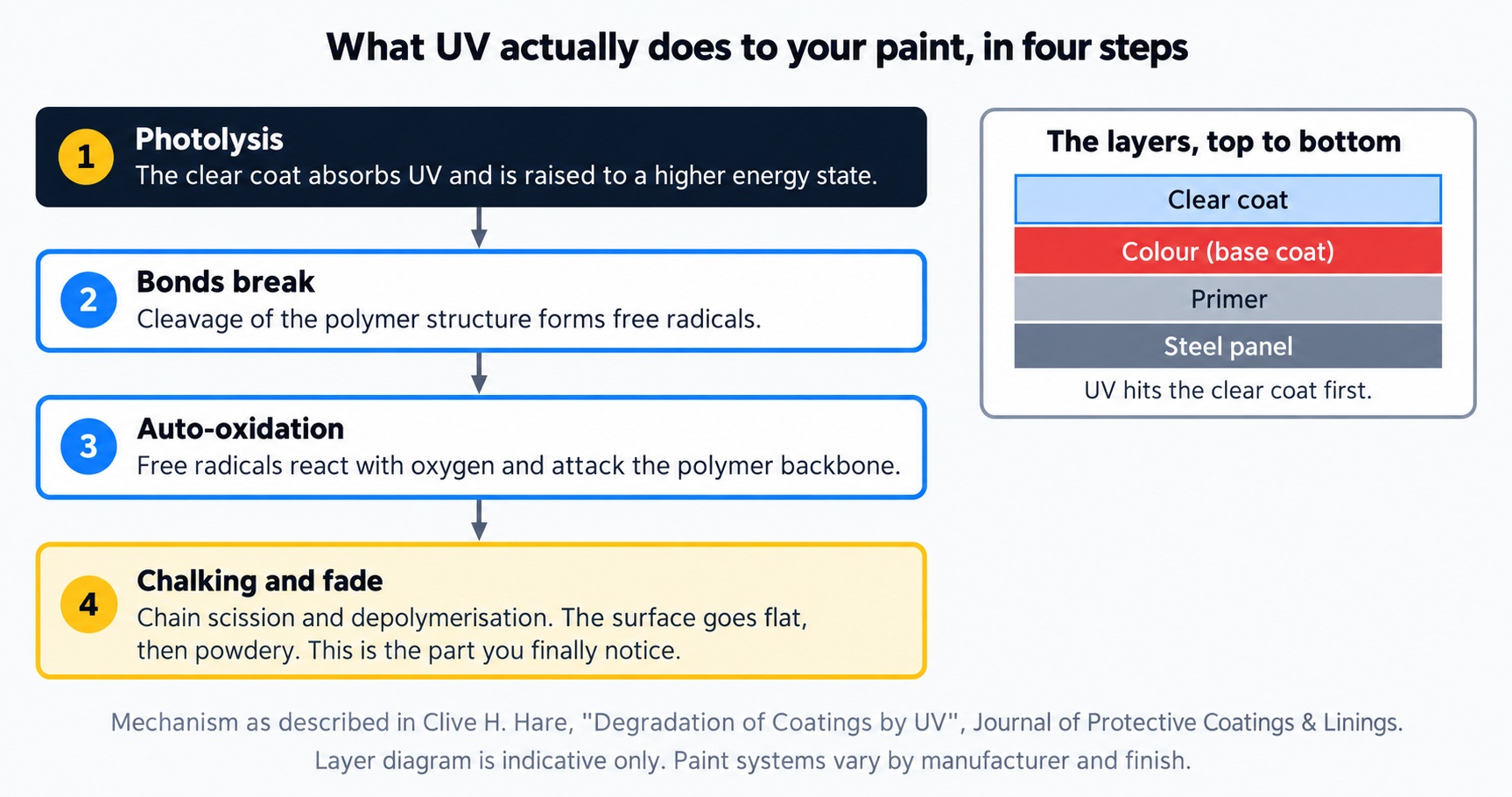
Your paint is a stack. Steel, primer, colour, then a clear coat on top. That clear layer is what you see and what you wash. It’s also the layer doing all the suffering.
The chemistry is well documented. In photolysis, as one coatings paper puts it, “the polymer absorbs ultraviolet radiation, and, as it does, becomes excited and is raised to a higher energy state than normal”. That energy goes somewhere: into “cleavage of the primary bonded structure of the polymer to form highly reactive free radicals”.
Then oxygen joins in. Those free radicals react with it to form peroxy radicals, which attack “the polymeric backbone by abstracting (removing) a hydrogen atom”. The result is chain scission, depolymerisation, and small fragments of the coating literally evaporating away. Where pigment is exposed, the same process produces “severe chalking” , that powdery residue you get on your fingers off an old red bonnet.
UV hits the clear coat first. By the time you notice fade, that layer has partly broken down.
The useful thing to take from that: by the time paint looks faded, you’re not looking at dirty colour. You’re looking at a clear coat that has partly broken down.
Australian sun is a harder test than most paint gets
This isn’t national pride, it’s measured. ARPANSA states plainly that “Australia experiences some of the highest levels of solar UVR in the world”, and gives the reasons: “relatively clear atmospheric conditions and the influence of ozone depletion over Antarctica contribute to higher levels of solar UVR in the southern hemisphere than at similar latitudes in the northern hemisphere”. On top of that, “the earth’s elliptical orbit brings the earth closer to the sun in January, during summer in the southern hemisphere”.
The Bureau of Meteorology’s UV Index runs from 1 to 11 and above, and the Bureau notes there is “no upper limit in the UV Index”. A car parked in an open lot through an Australian summer is getting a dose that a car in most of Europe simply never sees.
Is UV Damage Already Showing on Your Car?
Faded or dull paint? Our team can assess your car and recommend polishing or paint protection to help restore and protect the finish.
Wash it and look again. Dirt comes off. Fade doesn’t. If the panel is still flat after a proper clean, it’s the clear coat.
Compare a horizontal panel with a vertical one. Roof, bonnet and boot take sun all day; doors and guards don’t. A bonnet noticeably duller than the doors is UV, not grime.
Feel it. A healthy clear coat is slick. A degraded surface catches slightly under a clean, dry hand.
Check for chalk. Wipe a dry microfibre over a suspect panel. Colour transferring onto the cloth is the chalking stage, and that’s well past cosmetic.
Where it shows up first, and why
Always the flat panels. Roof first, then bonnet, then boot lid. They sit closest to perpendicular to the sun for the longest part of the day, so they collect the most energy. Wing mirrors and plastic trim usually go before the metal does, because unprotected plastics fade, discolour and crack on the same clock.
Which is why a car can look fine from the driver’s seat and tired from a first-floor window. Most owners never see their own roof.
What actually slows it down
Park in shade or under cover where you can.Unglamorous, and the one variable you control most easily.
Wash regularly. RACV recommends “washing your car once a week” to remove contaminants; RAC WA suggests “no more than once a fortnight, with quality car cleaning products”. Two motoring bodies, two answers somewhere in that range is fine, and the point is consistency rather than the exact number.
Get droppings and sap off promptly. RAC WA notes bird droppings “are acidic” and “can leave permanent marks on your car’s paint if left for too long”. RACV puts it the same way: remove them “as soon as you notice”.
Keep a protective layer on the paint. RACV describes waxing as helping “to create a protective layer that shields the paint from UV rays, dirt, and other contaminants”, with sealants offering “longer-lasting protection” and ceramic coatings acting “as a protective barrier against UV rays, oxidation, bird droppings, and chemical stains”.
None of that stops UV. It reduces the risk of the surface going the way described above, which is a different and more honest claim. If you want to compare the protection options properly, we’ve covered whether ceramic coating is worth it and car waxing in their own articles rather than repeating them here.
Once it’s faded, can you get it back?
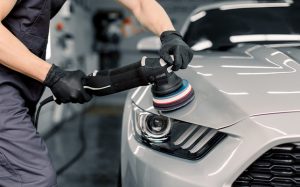
Partly, and it depends how far it’s gone. Machine polishing removes the oxidised top of the clear coat and exposes sound material underneath, which is why a properly polished panel can look close to new. But you’re removing material, and there’s a finite amount of clear coat on the car. Do it endlessly and there’s nothing left to cut.
If the fade has gone through the clear coat into the colour the chalking stage polishing won’t bring it back. That’s a respray, and it’s a body shop job rather than a detailing one. The window between “dull” and “too far” is the reason to deal with it while it still just looks dull.
Deal with it while it’s still dull
Fade is one of the few paint problems that gets meaningfully more expensive the longer you leave it, because the fix moves from polishing to refinishing. If your roof or bonnet has gone flat, our Polish and Paint Protection packages are the two that deal with it, and current pricing for every tier is on that page.
Muscle Hand Car Wash is in the North Car Park at Wollongong Central, Level G/57 Market St, and on Church St in Parramatta. Call 0430 601 901, or read up on why paint protection matters before you decide.
Protect Your Car Paint From UV Damage
Faded or dull paint? Our polishing and paint protection services can help restore and protect your car’s finish.
If the clear coat is still intact, yes machine polishing removes the oxidised layer and restores gloss, and a protective layer afterwards reduces the risk of it coming straight back. If the clear coat has broken down through to the colour, polishing has nothing sound to cut back to and the panel needs refinishing.
Does WD-40 remove oxidation on car paint?
It isn’t a paint-correction product. Anything it appears to fix is oil sitting in the degraded surface, making it look wet and darker for a while. It washes off, the oxidation is still there, and you’ve added something to strip before any real correction can start.
Why has my car paint faded?
UV is the main driver: it breaks down the clear coat from the surface down, and Australia’s UV levels are among the highest in the world. Heat, acidic contaminants like bird droppings and sap, and washing with the wrong products all speed it up. Cars parked outside on flat, unshaded ground fade fastest.
What is the best car polish to restore faded paint?
The product matters less than the process. Faded paint needs a cutting stage to remove the oxidised material and a finishing stage to bring the gloss back, done with the right pad, the right speed and the right pressure for that paint. A bottle of polish applied by hand will make a mildly dull panel look better for a fortnight; it won’t correct genuine oxidation.
Does washing more often prevent fading?
It reduces the risk. Washing removes the acidic and abrasive contaminants that attack the clear coat alongside the UV, so a regularly washed car holds its finish longer. It doesn’t stop UV, which is why a protective layer and shade do the other half of the work.



 September 8, 2026