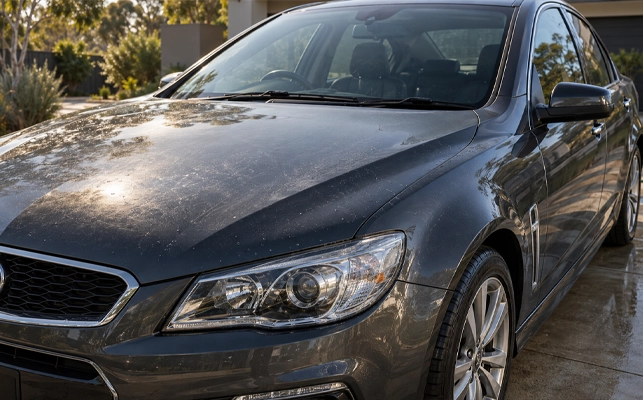
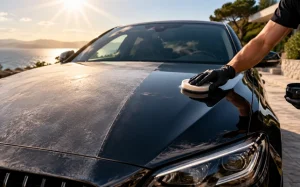
Your car is clean and it still looks grey in daylight. That is not a washing problem. It is contamination, mineral spotting and swirl marks, and each one needs a different fix.
Muscle Hand Car Wash
Muscle Hand Car Wash
October 15, 2026
Table of Contents
A wash lifts what is sitting loose on the paint. It does not touch the three things that actually flatten a finish. Contamination bonded into the clear coat. Mineral spotting dried onto the panel. Fine swirl marks already in the top coat. Clean and glossy are two different jobs. One is washing. The other is decontamination and polishing.
That is why the car can come out spotless and still look grey when you park it in the sun on Market Street. Nothing has gone wrong with the wash. The wash just finished its job earlier than you expected. Here is what is left behind, and which one your car probably has.
A wash removes what sits on the paint, not what has bonded into it
Panels collect more than dirt. Brake dust, airborne fallout, road tar, tree sap and bird droppings all land on the clear coat and stay there. Some of it etches in. Shampoo and a mitt will not lift it. It is no longer sitting on the surface. It is part of it.
There is a simple check. Wash and dry a panel, put your hand in a thin plastic bag, and run it lightly across the bonnet. Smooth means the paint is clean. Gritty means it is contaminated. Grit scatters light, and scattered light reads as dull.
Timing matters more than most people think. RACV’s guidance on paint protection is blunt about the worst offenders: “Remove droppings and tree sap as soon as you notice it. Left untreated these substances can cause permanent damage.” RAC WA adds the other half — how you remove them. Its car cleaning guidance says: “Never use anything with a sharp edge to scrape off dry bird droppings as this can scratch or chip your paintwork and leave irreversible damage.”
So the damage window is short, and picking at it makes things worse. Soften, lift, and leave the rest to a chemical decontamination and a clay treatment during a detail.
Water spots are minerals, not dirt
Water spots are what is left when a droplet dries on the panel and the dissolved minerals stay behind. They are not dirt. That is the whole problem. Car shampoo is built to lift dirt, so washing a spotted panel again just makes a fresh set of spots.
Heat accelerates it. A hot bonnet flashes the rinse water off before you reach it with a towel. RAC WA’s advice is direct: “Always wash your car in a covered or shady area without exposure to direct sunlight.”
Left long enough, spotting can etch a faint ring into the clear coat. At that point it is a polishing job, not a cleaning one. Glass is the exception — it holds spotting hardest and responds to different products. We have covered that separately in our guide to removing stubborn water spots from a windscreen.
Swirl marks sit inside the clear coat, so clean paint still scatters light
This is the one people miss, because swirls only show up in direct sun or under a service station light. Then the bonnet looks like it has a halo on it.
RACV explains where they come from: “Fine swirl marks and light scratches on a car’s paintwork are common. These are generally caused by tiny particles of dust or dirt being wiped along the bodywork during the car washing and drying process.”
In other words, they are put there by washing and drying. Which is why washing more often cannot remove them. RAC WA names the usual culprits on the drying side, warning against “a smooth cloth, soft towel or old T-shirt” because these “could potentially cause micro-scratches”. On the washing side, RACV recommends the two-bucket method: “To minimise the risk of scratching the paint, use two buckets: one with the soapy water, and one with clean water to rinse your sponge or mitt.”
Good technique reduces the risk of adding more. It does not remove what is already there. If you want the technique side in detail, read our breakdown of the car wash mistakes that damage paint.
Faded trim and hazy glass drag clean paint down with them
Paint is not the only surface a person looks at. Grey plastic trim, dull tyres and a milky windscreen all read as “tired car”. They pull the paint down with them, even when the paint is fine.
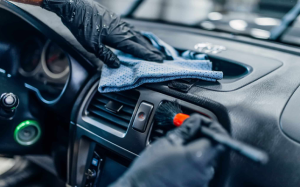
Glass is worth doing properly rather than quickly. RACV’s method: “Use a microfibre cloth and a quality glass cleaner to clear away grime before buffing the window with another clean microfibre cloth for a streak-free finish.” Two cloths, not one. For the cabin, RACV lists air vents and dashboards among the parts most often forgotten, and says to clean them with a microfibre cloth.
Book a proper look at the paint
Bring the car in and we will tell you which of these it actually has, and what it needs.
Once you know which cause you are dealing with, the work is straightforward. The order never changes: decontaminate, then correct, then protect.
What is dulling it
How it shows
What a wash does
What actually shifts it
Bonded contamination
Gritty feel, flat sheen in daylight
Very little
Chemical decontamination, then a clay treatment
Water spotting
Rings or cloudy patches that survive drying
Very little once dried on
Dedicated spot removal, then polishing if it has etched
Swirl marks
A halo under direct sun or a bright light
Nothing
Machine polishing with a light cutting compound
Faded trim and hazy glass
Grey plastic, milky windscreen
Cleans, does not restore
Trim dressing and a two-cloth glass process
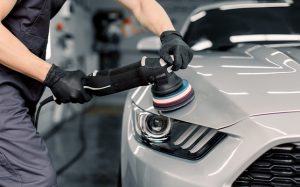
Polishing and waxing are not the same step, and mixing them up is why a lot of cars stay dull. Polishing is abrasive. RACV says such products “cleanse and polish light marks, blending them seamlessly into the rest of the top coat”. It also calls them light cutting compounds. So polishing removes a defect by removing a very thin amount of clear coat.
Wax does the opposite job. It adds a layer on top and protects the result you just paid for. Our car waxing guide has the full comparison.
How long that protection lasts depends entirely on what you put on. RACV’s comparison gives waxes “6-8 weeks”, sealants “Up to a year” and ceramic coatings “Up to five years”. If the long end of that is what you are after, we have set out the case either way. It is a ceramic coating worth it.
How to work out which one your car has
Do it in daylight, in a dry car, out of direct sun.
Feel first. Gritty paint points to contamination. Then move into the sun and look across the panel at a low angle rather than straight down — swirls only appear at an angle. Then look for defined rings or cloudy patches, which point to spotting rather than either of the other two.
If you find a mark that looks deeper than the rest, RACV’s fingernail test sorts it: “Run your fingernail over the scratch to assess its depth. If your fingernail doesn’t catch, the scratch may only have damaged the clear top coat. If your fingernail does catch, the scratch is likely deeper than the top coat.” A catch means polishing is not the answer. Our piece on detailing and small paint chips covers where that line falls.
Conclusion
Muscle Hand Car Wash, North Car Park, Wollongong Central, Level G/57 Market St, Wollongong NSW 2500. Phone 0430 601 901.
A dull finish is rarely one problem. It is usually contamination, spotting and swirls layered on top of each other. A wash was only ever going to shift the loose dirt. Work out which cause is doing the most damage. Fix that one properly. Then protect the result, so the next wash has less to undo.
Bring the shine back properly
From decontamination to polishing and protection, we’ll match the fix to what your paint actually needs.
No, and it can work against you. Swirl marks come from the wash and dry process itself, so more passes mean more chances to add them. RAC WA frames its advice as a ceiling rather than a schedule, recommending you wash a car “no more than once a fortnight, with quality car cleaning products.”
Can a car be polished too often?
Polishing works by removing a very small amount of the top coat, so it is a corrective step rather than a routine one. How much clear coat a car has left depends on its age, its history and whether it has been polished before. Have it assessed rather than repeated on a schedule.
Does dull paint mean the paint is damaged?
Not on its own. Contamination and water spotting sit on or just into the surface and usually come back with decontamination and polishing. Damage is a separate question, and the fingernail test above is the quickest way to tell the two apart.
Is polishing the same as waxing?
No. Polishing removes a defect. Waxing adds a protective layer over the finish once the defect is gone. Doing the second without the first seals in the dullness.


 October 15, 2026